

Why does society feel increasingly unstable when we spend so much energy trying to fix it? We debate policies, change leaders, demand economic relief, and look for the next political solution. Yet we can overlook the institutions that form the people who make a society work.
I believe two institutions are essential to freedom and human flourishing: the family and the church. And even the strength of the family is deeply connected to the life of the church.
That conviction asks something of us. If the church of Jesus Christ is central to bringing light, liberty, compassion, and truth into the world, then building the church cannot remain an optional extra in the Christian life. It belongs at the heart of following Jesus.
Key Takeaways
- Strong churches and families form the character that supports freedom, responsibility, and human flourishing.
- Government can serve good purposes, but it cannot replace Christ as the source of Christian hope.
- Giving should arise from faith, hope, and love rather than fear or promises of automatic prosperity.
- Following Jesus includes commitment to His church and respect for every person’s God-given dignity.
Worldviews Shape More Than Our Private Beliefs
Years ago, I loved reading Understanding the Times by David Noebel. What made it so compelling was its comparison of Christian, secular humanist, and communist worldviews across disciplines such as science, biology, psychology, sociology, politics, and history.
The familiar Christian material was not what most challenged me. It was encountering other worldviews through the words of their own advocates. You could begin to understand how they saw the world, what they hoped to create, and how their ideas connected across different areas of life.
That is important because a worldview does not stay inside someone’s head. It shapes education, economics, family life, political authority, and our understanding of human worth. Our deepest beliefs eventually take institutional form.
One argument I remember from that reading was that undermining America required undermining the family and the church. What struck me was the recognition that these institutions stand between the individual and an all-powerful state.
Consider the logic of tyranny. The person exists to serve the state, and nothing may compete with the state’s ultimate claim. A family with its own responsibilities, loyalties, and authority becomes an obstacle. A church proclaiming that Jesus Christ is Lord becomes an even greater obstacle.
The church declares that government is not God. The state does not own our children, our consciences, or our ultimate allegiance.
The violence and oppression associated with communist revolutions in Russia and China, along with the economic failures of central planning, are part of why I take that distinction seriously. China’s movement toward market activity also challenges the assumption that centralized control can supply everything a society needs.
But the Christian answer is not simply to oppose a political ideology. It is to recognize and strengthen what protects people from domination: families that nurture responsibility and churches that teach people to live under the lordship of Christ.
Strong Families Pass Faith and Character to the Next Generation
How often do we stop and consider the public importance of family life? Marriage, parenting, education, and faithfulness may seem like private matters. Their consequences are anything but private.
Christian teaching about marriage and family has helped shape the world we inhabit. In reading writers such as Vishal Mangalwadi, I have been challenged to consider how the biblical vision of faithful marriage contributed to the development of Western civilization. The Reformation also renewed attention to marriage and household life as places of meaningful service to God.
The point is not that every Christian household has fulfilled that vision. The point is that the vision matters. Faithfulness, responsibility, and the care of children do not become less significant because they happen around a kitchen table rather than in a government office.
Family and education belong together
The endurance of the Jewish people has also caused me to reflect on the importance of family and education. Through exile, displacement, and persecution, the transmission of faith and identity within households and communities has mattered profoundly.
There is a biblical foundation for that commitment. In Deuteronomy 6:6-9, God’s people are instructed to teach His words diligently to their children, making them part of ordinary daily life.
I remember knowing Jewish children on my school bus route who attended additional religious schooling after their regular school day. Even before I understood much about their faith, I could see that education was a priority.
That raises a question for us: Are we treating the formation of the next generation as essential, or as something we will get around to when life becomes less demanding?
Flourishing requires character, not merely ambition
A man from Mexico City once told me about the hostility he encountered as his hard work began to improve his circumstances. A better car and a better home led some people he had grown up with to assume he thought himself superior.
His response was not contempt. He saw himself as blessed and wanted to help others learn what had helped him.
That is a very different spirit from jealousy. Scripture, including James, warns us about the disorder that envy produces. Instead of resenting another person’s progress, we can ask what is good, what can be learned, and how blessing can be shared.
Now, this must not become a simplistic claim that everyone’s circumstances are entirely their own fault. Sickness, tragedy, and events beyond our control are real. The idea that everyone can simply pull themselves up by their own effort can become cruel.
Nevertheless, hard work generally serves a person better than drunkenness or destructive habits. Honesty serves a community better than deceit. Compassion serves our neighbors better than exploitation.
Imagine a society filled with people who are:
- Truthful and trustworthy.
- Diligent and responsible.
- Kind, compassionate, and merciful.
- Willing to help others rather than resent them.
Would that be a better world? Of course it would. Those are precisely the kinds of people the church should be forming through the gospel.
Government Is Not Our Savior, but It Need Not Be Evil
I sometimes meet people who believe all government is evil and that freedom requires abolishing it. But what happens when everyone is free to do whatever they want without restraint? The strongest can impose their will on everyone else. Removing government does not automatically remove oppression.
Others call government a necessary evil. I do not think that goes far enough biblically either. Scripture presents rulership and order as things that can serve God’s purposes. We proclaim Jesus as Lord. His government is not evil.
The problem is not government itself. The problem is evil, immoral, or foolish government.
That distinction allows us to ask a better question: What would make government a blessing?
If we are convinced good government is impossible, we may never seriously consider the moral conditions that could make it possible. A government shaped by truth, justice, restraint, and concern for people would be different from one shaped by greed and the will to power.
This brings us back to formation. Where do people learn those qualities? How do we cultivate a population that values them, including among those who govern?
Political structures matter, but they cannot substitute for transformed human beings. And political involvement cannot substitute for the mission of the church.
Haggai: Building Our Own Houses While God’s House Lies Neglected
Haggai 1:3-8 presents an uncomfortable picture. The people are living in their own finished homes while the temple remains in ruins. They plant much but harvest little. They eat without satisfaction. Their wages seem to disappear as though their money were being carried in a bag full of holes.
That description sounds painfully familiar to people who feel squeezed by rising prices. We work hard, but it seems harder to get ahead. There is pressure everywhere.
Our instinct is often to make government the center of the conversation. Government must rescue us. Government must lower prices. Government must provide the answer.
But is that where Christian hope belongs?
There is also a moral danger in demanding present comfort without asking who will bear its cost. Growing debt and unfunded obligations can shift burdens onto our children and grandchildren. We cannot claim to love future generations while refusing to consider what we are leaving them.
Haggai directs God’s people toward a different examination: Consider your priorities. Why are you building your own household while neglecting the house of the Lord?
God tells them to gather materials and rebuild the temple so that He may be honored. Later, Haggai connects the renewed work with God’s promise of blessing. The people are being called to trust God enough to act before they see the full result.
Rebuilding the church is not magical thinking
We need care when applying an Old Covenant passage to the church. Haggai speaks within a particular covenant setting. The temple was the place associated with God’s dwelling among His people, and its neglect carried covenant significance.
There is a spiritual dimension here, but we must not turn it into superstition. The message is not that church attendance mechanically fixes an economy, or that every financial difficulty proves someone has neglected God.
The practical connection is already powerful enough. When the church fulfills its calling, people learn to tell the truth, keep their word, work diligently, show mercy, and refuse to exploit one another. Those changes bless households, workplaces, and communities.
There are also biblical pictures of creation flourishing in God’s presence and suffering under sin. We should not dismiss that spiritual reality. But neither should we bypass the plain moral reality: a society of trustworthy, compassionate people will be different from a society of selfish, dishonest people.
We often say we cannot give the church more attention because we are busy caring for our families, earning a living, or finding a little time to rest. Those pressures are real. Yet Haggai challenges the assumption that our private lives can remain healthy indefinitely while God’s house is neglected.
If we want a better world for our families, building the church belongs among our priorities, not outside them.
Malachi: Giving Through Faith, Hope, and Love
Malachi 3:8-12 confronts the withholding of tithes and offerings. God calls His people to bring provision into His house and describes a land restored to fruitfulness, protected from destruction, and recognized by the nations as blessed.
Again, the connection is between the life of God’s house and the well-being of the community.
But we can badly distort that message. God is not impoverished because we fail to give. He does not become less God. In neglecting His purposes, we also deprive ourselves and our communities of what He intends His house to provide.
That is very different from treating giving as a supernatural transaction: put money in, receive prosperity out.
Churches can manipulate people by promising automatic financial rewards or threatening disaster if they do not give. That may fill an account, but manipulation does not build the kingdom of God.
The motivation matters. The church must cultivate faith, hope, and love, not fear and greed.
- Faith: We give because we believe God is good and His purposes are worthy of our trust.
- Hope: We invest because we believe His work can bless this generation and those who come after us.
- Love: We support the church because we love God, our neighbors, our children, and future generations.
The greatest of these is love. But faith is an essential starting point. Do we actually believe the church matters? Do we believe the world suffers when the church lacks the commitment and provision needed to fulfill its mission?
Think of the image of a church standing at the center of an older town. Whatever the shortcomings of any particular community, that placement communicated a priority: the house of God belonged at the heart of shared life.
The question is whether the church still occupies that kind of place in our hearts.
The Gospel Makes People Living Evidence of God’s Goodness
The Old Covenant contains pictures and promises that find their fulfillment in Jesus Christ. The blessing of the nations is not an afterthought. It belongs to God’s heart for the world.
When the gospel spread into the Gentile world, the new churches did not simply reproduce Jewish culture. Yet the presence of Jesus and the work of the Holy Spirit were recognizable. God was creating a people whose lives testified to His goodness.
That is the idea behind believers becoming living letters. Their lives make something visible:
- People released from fear and bondage.
- Human dignity and worth restored.
- Lives given significance and purpose.
- Communities learning a different way to live.
The gospel is a treasure worth surrendering everything to possess. Its value becomes evident not only in what we say, but in what we become.
I have been struck by accounts of scholars and religious thinkers outside Christianity recognizing the relationship between Christian belief and the flourishing of Western societies. I also remember reading an account of leaders in Argentina who wanted the benefits they saw in prosperous nations and debated whether those benefits could be separated from the faith that helped form them.
These accounts bring us back to the same question: Can we keep the fruit while dismissing the source of the character that produced it?
For the Christian, the church is central to that work. It is where the gospel is proclaimed, shared life is formed, and people learn together to follow Jesus. That relationship between Christian formation and public life also runs through our wider collection of biblical preaching and teaching.
When Christian Slogans Undermine the Church
One of our most urgent tasks is restoring the value of the church in people’s hearts and minds. Part of that work involves examining language that sounds spiritual but can quietly weaken our commitment to the body of Christ.
I think of destructive teaching as good food with poison mixed into it. An obviously false idea is easier to reject. Something mostly true, with a harmful implication attached, can travel much farther.
Consider the claim that our desires or beliefs create reality. The law of attraction can sound empowering until we ask a simple question: What happens when two people want the same exclusive outcome? Whose desire wins?
Or consider the claim that everyone creates a private reality. Are other people genuinely real and distinct from us? They must be if love is to mean anything. Love requires another person, not merely a projection of ourselves. Real relationship involves encountering someone who is not under our control.
That same concern about self-centered spirituality helps us examine two familiar church slogans.
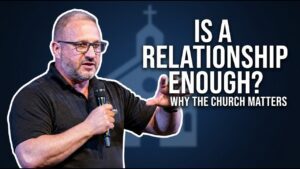
Relationship with Jesus does not make the church unnecessary
The contrast between religion and relationship arose partly as a response to something genuinely wrong: lifeless religion, empty performance, hypocrisy, and religious activity without the Holy Spirit.
We should reject those things. But rejecting dead religion is not the same as rejecting the corporate life of God’s people.
When the message becomes “all that matters is my personal relationship with Jesus,” the church can begin to seem irrelevant. Evangelism then shrinks to securing a prayer or an assurance about heaven without any expectation that a person will become committed to Christ’s body.
Personal faith matters deeply. But personal faith is not a substitute for belonging to the people Jesus is building.
We must also admit that churches have contributed to their own rejection. There are real problems to confront and real practices to reform. Restoring the value of the church does not mean pretending the church has everything right.
It means refusing to confuse the correction of false religion with the abandonment of the church itself.
The people matter most, but the institution matters too
It is true that the church is people rather than merely a building. But what conclusion are we drawing from that truth?
A family is not a house. The people are what make it a family. Yet a home can shelter that family, support its life, and become a place where relationships grow.
Likewise, a church building is not the whole church, but shared places, resources, and organized responsibilities can serve the people and their mission. Saying that people matter most does not make the institution meaningless.
The danger is using a true statement to justify an isolated Christianity in which corporate commitment has no claim on us.
A Church That Honors Jesus Must Honor Every Human Being
If people are the most precious part of the church’s life, we must be clear about which people we mean.
Every person. No exceptions.
Every human being bears the image of God. That is why I am deeply wary of ideas that describe other people as less than fully human. Whether the language comes from conspiracy theories, racial contempt, political hostility, or religious speculation, the danger is the same: it can excuse mistreatment.
Someone’s political party does not erase the image of God. Neither does their nationality, ethnicity, or place of birth.
The parable of the Good Samaritan confronts our habit of withholding humanity from the person we consider an outsider. Jesus makes the despised neighbor visible as a person capable of mercy and worthy of moral attention.
We cannot claim to bring heaven’s character into the world while dehumanizing the people God calls us to love.
Jesus Is Building His Church. Are We Joining Him?
In Matthew 16:18-19, Jesus announces His commitment to build His church and declares that the gates of Hades will not overcome it.
What is Jesus doing? He is building His church. If we call ourselves His followers, should we not be committed to what He is committed to?
The picture of gates is significant. Gates hold people within a domain. I understand Jesus’ promise as a picture of His church participating in liberation, bringing people out of bondage rather than merely struggling to survive.
He also speaks of the keys of the kingdom and of binding and loosing. In the Jewish religious setting, that language was associated with authoritative judgments about what was permitted and forbidden, what belonged within the bounds of faithful life and what did not.
We diminish the passage when we reduce it to formulas for commanding desired outcomes. Its concern is larger: the church is entrusted with a mission to reflect the character, ways, and rule of Jesus on earth.
That means embracing what agrees with heaven and refusing what contradicts it. Truth rather than deception. Mercy rather than cruelty. Freedom rather than bondage. Human dignity rather than contempt.
Jesus loves His church. Scripture describes her as His bride. Following Him must include learning to love what He loves.
Corporate unity accomplishes what isolation cannot
Imagine isolated individuals trying, one by one, to stop the organized military power of World War II. Sincerity and courage alone would not have supplied what coordinated resistance required.
The analogy is about the power of unity, not a call to physical conflict. Organizations, corporations, and governments understand that shared purpose multiplies capacity. Christians should not be the last people to recognize the significance of acting together.
The church is not a collection of disconnected spiritual consumers. It is a people called into common life and common mission.
Our Hope Belongs in God’s House, Not the White House
Our understanding of the future shapes how we live now. If Christianity becomes only a personal arrangement for leaving earth and reaching heaven, we may quietly surrender responsibility for this world.
But Jesus’ death and resurrection proclaim Him Lord of all. My conviction is that His messianic reign has begun and that He is making His rule known through His church.
That gives us reason for hope, not withdrawal.
Esther’s story offers a searching picture. Mordecai warns her not to assume she will remain safe simply because she occupies the palace. Her position carries responsibility. Perhaps she has come to that place for precisely that moment.
At the same time, Mordecai’s confidence rests in God’s faithfulness. Deliverance does not finally depend on one person’s willingness. God’s promises stand. But each person must decide whether to participate in His purposes.
That is how we should approach the church’s future. Jesus will build His church. Scripture points toward a bride made ready, a people growing into the fullness of Christ, and the final defeat of death.
Our question is whether we will join Him faithfully in this generation.
We rebuild the church because we believe, because we hope, and because we love. We give it our attention, commitment, and resources because Jesus is worthy and His purposes are good. We strengthen families while refusing to neglect the community that helps form them.
The salvation we need will not originate in the White House. It comes from God, and His house must not be neglected.
If Jesus is Lord, let us value what He values, love what He loves, and join Him in building His church.