
We all know how to make room for certain holy days.
Christmas is everywhere. Easter still carries weight in the culture. Even people who rarely think about faith tend to feel the pull of those moments. One celebrates the coming of Christ into the world. The other celebrates His victory through death and resurrection.
But there is another feast that should be just as central, and in many ways it explains how the Christian life is meant to be lived right now. That feast is Pentecost.
It is the missing feast.
The feasts were never random religious activities
When people hear about the biblical feasts, they often imagine a rigid religious calendar full of obligations. But that misses the heart of what God was doing.
Israel had what are often called the three pilgrim feasts: Passover, Pentecost, and Tabernacles. Technically there are seven feasts in the calendar, but they cluster around these three major celebrations.
Christian culture, broadly speaking, has held onto two great celebrations in public life:
- Christmas, centered on the birth of Jesus
- Easter, centered on His death and resurrection
What has largely disappeared is Pentecost.
That matters because the feasts were not empty rituals. They were designed to shape memory, identity, gratitude, hope, and imagination. They were meant to teach a people how to live in God’s world.
Passover, Easter, and the God who delivers
Passover begins a sequence that includes Passover, Unleavened Bread, and Firstfruits. Its imagery comes from God rescuing Israel from slavery in Egypt.
That alone is worth pausing over.
In a world full of oppression, cruelty, injustice, and despair, Passover says God is not powerless. He can break tyrants. He can free the oppressed. He can overturn what looks impossible. If we lose that, we lose wonder. We lose worship. We lose hope.
For Christians, that feast reaches its true meaning in Jesus. Easter is not disconnected from Passover. It is Passover fulfilled in Christ. He is the true Passover Lamb, the One through whom real deliverance comes.
Tabernacles and the meaning behind Christmas
The third great feast is Tabernacles, which also unfolds as a sequence: Trumpets, Atonement, and Tabernacles.
Tabernacles points to something beautiful. It is about God dwelling with His people. The word itself carries the sense of God making His home among humanity.
That is why it connects so naturally with Christmas. Christ is Immanuel, God with us. John’s Gospel describes the coming of Jesus with temple language, saying in effect that God pitched His tent among us. He came to dwell here.
So Christmas is not merely about a baby in a manger. It is about the Creator moving into His creation, making His presence known.
The feast we forgot: Pentecost
Pentecost sits between Passover and Tabernacles, and it carried two major themes in Israel’s life:
- The ingathering of the harvest
- The giving of the law at Sinai
That second part is easy to miss, but it is astonishing.
Israel received covenant and constitution before they received the land. Think about how strange that is. A people without a homeland were given the shape of life they were meant to embody. God did not wait until they were settled to tell them what justice, mercy, holiness, and community should look like.
Why?
Because the real issue was never just geography or political structure. God was forming a people capable of carrying freedom. He was taking former slaves and teaching them how to live as image bearers rather than as people shaped by bondage.
That process took time. Forty years in the wilderness was not meaningless delay. It was formation.
The point is profound: you cannot build a world that reflects heaven merely from the top down. External systems are not enough. Hearts have to be transformed. People have to be formed in justice, mercy, faithfulness, and love.
God’s feasts were celebrations, not tools for appeasing an angry deity
Many people still approach biblical worship with a pagan mindset. The assumption goes like this: do the ritual, make the offering, keep God calm, and maybe He will not judge you.
But that is not the heart of the biblical feasts at all.
Yes, sacrifice was part of Israel’s life. But the deeper purpose was formation and instruction. God was dealing with people who had lived in Egypt for centuries. Temple and sacrifice were the symbolic world they knew. So He met them where they were, but He was always teaching them toward something deeper.
The foundation underneath all the feasts was Sabbath. Sabbath says human life is not meant to be consumed by endless production. We are not here for perpetual burnout. We are here to enjoy the goodness of God, to worship, to celebrate, to rest, and to remember what life is for.
The feasts built on that same logic.
They were giant holy celebrations. They were times to gather, rejoice, eat, remember, and give thanks. They were so communal that if someone was poor and could not afford to join the feast, they were to be brought in and included.
This is not the religion of grim spiritual survival. This is the life of a people taught to celebrate the goodness of God together.
That is one reason it is helpful to revisit solid biblical teaching regularly through resources like the preaching videos archive. We need reminders that God’s way is fuller, richer, and more life-giving than many of us were taught.
The law of the Lord is liberty
There is a worldly spirituality that treats detachment from joy as maturity. It says the holy person is the one who no longer cares much, no longer delights much, no longer expects much.
But the biblical vision is very different.
God teaches His people to rejoice with those who rejoice and grieve with those who grieve. He does not call us to become numb. He calls us to become fully alive.
That means delight is not automatically selfish. Celebration is not automatically worldly. Receiving a gift with gratitude can itself be an act of obedience.
If God has given a good thing, and it does not require neglecting responsibility or harming anyone else, then enjoying it can be part of holy living. That is part of what the feasts teach us. Life is not redeemed by becoming less human. It is redeemed by becoming rightly human in the presence of God.
Why Pentecost stirs such deep joy
For many believers, the word Pentecost does not mainly stir theological categories. It stirs memory.
It brings to mind the experience of the Holy Spirit, the nearness of God, the joy of worship, the brightness that comes when Christ becomes more than an idea.
When the Holy Spirit is known in that way, faith stops feeling dry. Worship stops feeling forced. Gratitude rises naturally. Joy shows up in the face. Hope returns to the eyes.
That is why seasons of spiritual renewal have often carried such unmistakable gladness. People who have freshly encountered the Spirit of God often smile more, hope more, sing more, and carry a deeper steadiness through hardship. Not because their problems vanished, but because Christ became vividly real.
The world constantly trains us to stare at what is broken. And of course there is much that is broken. But the normal Christian life is not meant to be defined by chronic fixation on darkness. It is meant to be marked by praise, thanksgiving, wonder, and confidence in Jesus even in the middle of suffering.
What Pentecost is
Acts 2 gives the defining Christian moment of Pentecost.
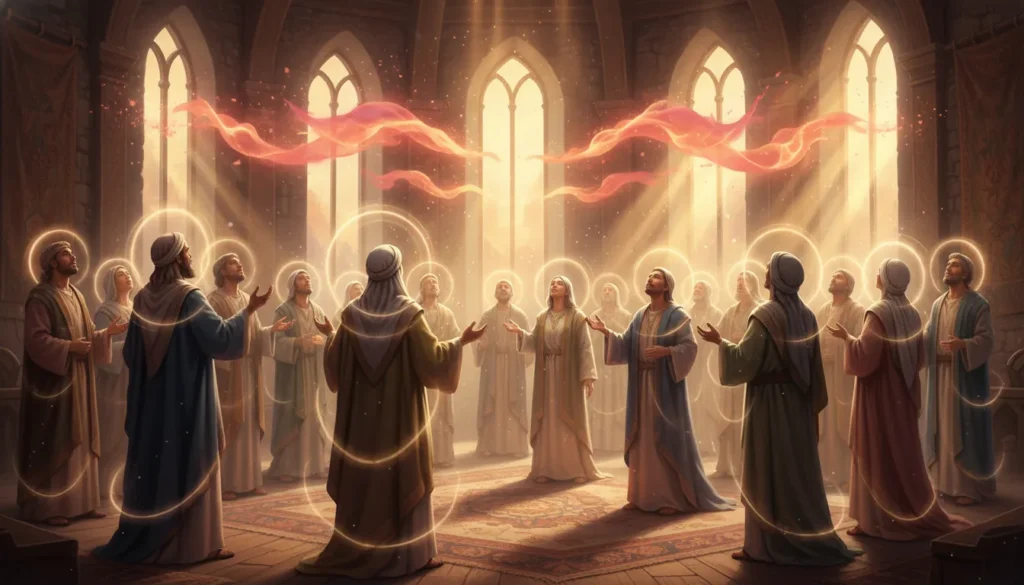
The disciples were together in one place, united in heart. Then came the sound like a mighty wind. Fire-like tongues appeared over them. They were filled with the Holy Spirit and began speaking in other languages as the Spirit enabled them.
That story is often reduced to one visible feature, usually tongues. But the better question is this:
What does Pentecost mean?
If we only fixate on the phenomenon, we miss the message.
Pentecost happened in unity
Before the wind, before the fire, before the languages, there was something simple and vital: they were together in unity.
That matters.
The Holy Spirit is not given to encourage isolated religious individualism. Pentecost happens in community. It happens among a people gathered around Jesus.
And just as unity makes room for the Spirit’s life to be expressed, constant unbelief, cynicism, corrosive criticism, and fixation on discouragement can choke spiritual vitality. Scripture warns against quenching the Spirit for a reason.
It is not merely about rejecting certain gifts. It is also about living in ways contrary to faith, hope, and love.
What they were actually saying
One beautiful detail in Acts 2 is that the content of their Spirit-filled speech is not left completely vague. They were declaring the mighty works of God.
That is a clue to the heart of Pentecost.
Being filled with the Spirit is deeply connected to celebrating who God is and what He has done. It is not random excitement. It is doxological. It is worship erupting from a people overwhelmed by God’s greatness.
That is why praise and Spirit-filled life belong together.
Pentecost announces the reign of King Jesus
The day of Pentecost was not only a spiritual experience. It was a royal announcement.
Its imagery points toward enthronement. Messiah has been exalted. The King has taken His seat. The age of His reign has begun.
So what is Pentecost really proclaiming?
Jesus Christ is Lord.
That is the center of it all.
The Spirit is poured out because the Messiah reigns. Pentecost is the public declaration that the kingdom of God has broken into history in a new way through the crucified and risen Christ.
Why the many languages mattered
People from many regions heard the mighty works of God in their own languages. This was no small detail. It was a sign.
It announced that the reign of Messiah was not for one tribe only. Not one ethnicity. Not one nation. Not one corner of the earth.
All nations are in view.
The good news is for the whole world. The hope of Israel is the hope of the nations. Pentecost is the beginning of a global ingathering.
If you want a broader sense of how this message has been preached and revisited over time, the Pastor Bill Brannan video archive is a helpful place to continue exploring these themes.
The last days began with Pentecost
When Peter explains Pentecost, he reaches back to the prophet Joel and says that in the last days God would pour out His Spirit on all flesh.
That means Pentecost is the inauguration of the last days, not merely a strange event floating free from history.
And what do those last days look like?
- God’s Spirit poured out broadly
- Sons and daughters speaking forth God’s word
- Young people seeing vision
- Old people dreaming dreams
- A revived people marked by hope
That is the opposite of spiritual exhaustion. It is the opposite of cynicism. It is the birth of a Spirit-filled people who dare to imagine the world healed because the Spirit of God has been given.
What the apocalyptic language is really doing
Peter’s quotation includes dramatic cosmic language: darkened sun, blood-red moon, signs above and below. Many people hear that and immediately imagine a disaster film.
But the prophets regularly used that kind of language to speak about the collapse of kingdoms and the overthrow of systems of power.
In other words, Pentecost announces more than private inspiration. It announces judgment on the old world order. Tyranny, injustice, oppression, and everything aligned against the kingdom of God are being challenged by the reign of Jesus.
And yet right in the middle of that warning comes mercy: everyone who calls on the name of the Lord will be saved.
That is the heart of God. He judges what destroys life, but He desires rescue. His preferred means of cleansing the world is not simply removing sinners, but transforming them.
That is why the conversion of a violent persecutor into the apostle Paul is such a vivid picture of judgment and mercy meeting. The old man perishes. A new creation rises. The earth is cleansed through redemption.
Pentecost is how God changes the world
This is where the message gets uncomfortably direct.
We keep being tempted to believe the world will finally be fixed through political dominance, external force, better systems, tighter control, stronger enforcement. But Christianity insists that the deepest problem is not first political. It is spiritual and moral. It is sin in the human heart.
That is why Pentecost matters so much.
God does not transform the world primarily through top-down coercion. He transforms it from the inside out through people made new by the Holy Spirit. Laws can restrain. Governments can serve useful purposes. But they cannot create holiness, love, or new hearts.
Only Jesus can do that.
The purpose of Pentecost: rivers of living water
Jesus gave one of the clearest windows into Pentecost during the Feast of Tabernacles. He cried out that anyone who thirsts should come to Him and drink, and that from within the believer would flow rivers of living water. John explains that He was speaking about the Spirit.
This is not small imagery.
The world is thirsty. Humanity aches for healing, hope, peace, restoration, and life. We are a dry land in desperate need of water.
And Pentecost is God’s answer to that thirst.
The Spirit is not given merely so individuals can have private comfort. The Spirit is given so living water can flow outward and bring life.
The wilderness rock and the hope of the world
The imagery runs deep into Scripture.
Israel survived the wilderness because God gave water from the rock. That was not a luxury. It was survival. Without that water, they perish in the desert.
The New Testament identifies that rock with Christ. But the image grows even larger in the prophets and Revelation. There is a river of life flowing from the presence of God, a river that turns wasteland into garden.
That is the promise attached to the messianic age. The desert will not remain a desert forever. The Spirit of God will irrigate the earth.
For background on the biblical imagery of water, temple, and renewed creation, a useful outside resource is the BibleProject study on the water of life.
Why the church is central to Pentecost
Here is a truth the modern church badly needs to recover: the river of life flows from the temple, and the temple is now God’s people together.
That means the church is not an optional add-on to personal spirituality. It is central to God’s plan for healing the nations.
Pentecost was given to a gathered people in unity. The church is the dwelling place of God by the Spirit. The river is meant to flow through the people of God into a thirsty world.
That is why devaluing the church is so dangerous.
When faith gets reduced to “me and Jesus,” we miss the scale of what God is doing. He is forming a people, a bride, a temple, a Spirit-filled community through whom His life reaches the world.
Until the church is rebuilt according to God’s wisdom, the world remains more barren than it should be. The issue is not merely whether church buildings exist or meetings happen. The issue is whether the people of God are actually becoming the kind of Spirit-filled temple through which living water can flow.
Why Pentecost may be the feast our culture most needs
Perhaps part of the reason our moment feels so spiritually thin is that we have retained Christmas and Easter in broad cultural memory while largely neglecting Pentecost.
We remember Christ’s birth. We remember His resurrection. But we often forget the outpoured Spirit, the enthroned Christ, the new covenant written on the heart, the church as temple, and the river of life meant to heal the nations.
The new covenant is not simply old commandments repeated from the outside. It is God’s life written within. The Spirit empowers what stone tablets could never produce. The law is internalized. Hearts are changed. A new creation begins.
That is Pentecost.
It is the feast of the last days.
It is the feast of King Jesus reigning.
It is the feast of the Spirit poured out.
It is the feast of the church receiving power to become what she was always meant to be.
The missing feast needs to be recovered
To recover Pentecost is to recover several truths at once:
- Jesus is reigning now
- The Holy Spirit has been poured out now
- The nations are in view now
- The church matters now
- Transformation begins in the heart now
- The river of God’s life is meant to flow now
This is not a side doctrine for unusually expressive Christians. It is the heart of how the reign of Christ becomes visible in the world.
So yes, celebrate Christmas. Absolutely celebrate Easter.
But do not forget Pentecost.
Without Pentecost, we can end up admiring Jesus from a distance instead of being filled with His life. We can talk about heaven while neglecting the healing of earth. We can speak of faith while living powerless. We can reduce church to attendance rather than seeing it as the Spirit-filled temple through which God intends to bless the world.
The missing feast is not missing because it lacks importance.
It is missing because it confronts us with what God actually intends: a people transformed by the Holy Spirit, living under the reign of Jesus, and carrying living water into a thirsty world.