
A verse can sit in plain sight for years and still slip past us.
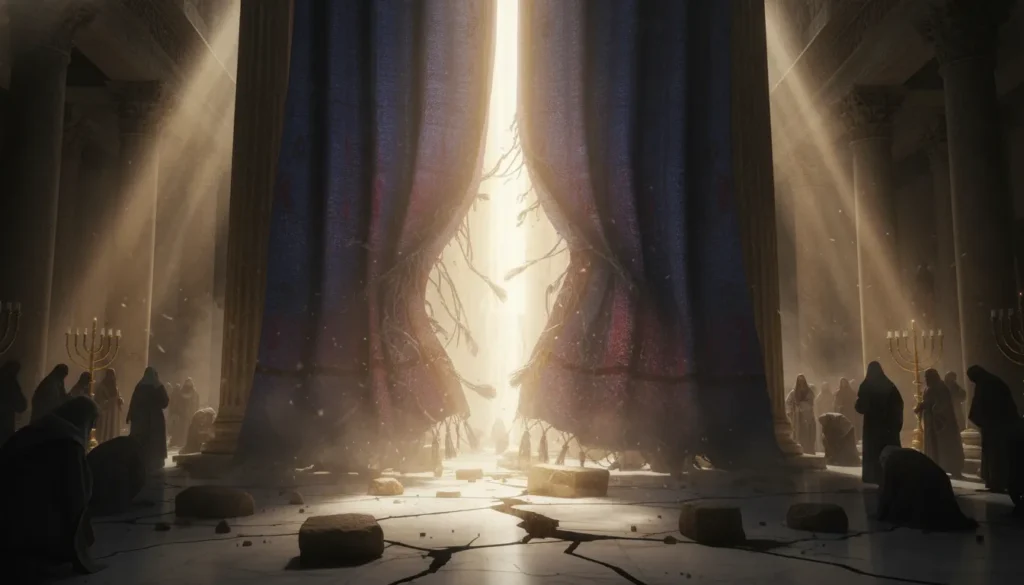
In Matthew 27, at the moment Jesus gave up His spirit, the temple curtain was torn from top to bottom. Most of us know the line. We read it around the crucifixion story, nod, and move on. But that torn veil was not a random dramatic detail. It was a revelation. It pulled back the curtain on what God had been doing all along and what changed forever through Jesus Christ.
The tearing of that veil was not only about access. It was also about transfer. It signaled the end of one order and the beginning of another. The old temple system had reached its conclusion, and God was establishing a living temple made of His people by the Holy Spirit.
Why the torn veil matters so much
The scene is full of upheaval. Jesus dies. The earth shakes. Rocks split. And then that massive curtain inside the temple is ripped apart from the top down.
That detail matters. This was not the sort of fabric somebody could grab with both hands and tear like an old bedsheet. Historical sources like Josephus describe the temple with a grandeur that helps explain the scale. The veil was enormous, layered, heavy, richly woven, and designed to separate the Holy of Holies from everyone else.
It represented distance. Protection. Warning. Separation between a holy God and sinful humanity.
So when that barrier is torn from top to bottom, heaven is making a statement. God is the one opening what man could not open. The curtain is being pulled back so we can finally understand what the temple was pointing to.
God has always wanted to dwell with His people
If you want to understand the temple, you have to go back much further than Jerusalem.
From the beginning, God’s purpose was to dwell with mankind and extend His rule through humanity into the earth.
Eden was the first temple pattern
We often read the Garden of Eden simply as the place where everything went wrong. But it was also a picture of sacred space. God walked there with man. He gave mankind a calling to be fruitful, multiply, rule wisely, and spread His order and glory outward.
The river flowing from Eden into the world is part of that picture. God’s life and rule were never meant to stay enclosed in one spot. His intention was always expansion, that His glory would fill the earth.
Holy meeting places continued through the patriarchs
After Eden, God kept meeting people in holy places. A burning bush. A ladder in a vision reaching between heaven and earth. Altars. Encounters. Moments where the natural and supernatural overlapped.
The pattern stays consistent. God seeks fellowship with His people and calls them into His purpose.
The tabernacle in the wilderness
Later, in the wilderness, Israel was given the tabernacle. It was essentially a sacred tent, but not just any tent. It was the place where God’s glory rested among His people. Sacrifices were offered there. Worship happened there. It was the center of divine presence in the camp.
That tabernacle said something powerful. God did not merely want commandments delivered from a distance. He wanted to dwell in the midst of His people.
The tabernacle of David
Then there was David’s tabernacle, which does not always get as much attention. Before the permanent temple was built, David established a place of worship in Jerusalem marked by openness and praise.
That matters because later prophetic language about the rebuilding of David’s tabernacle gets picked up in Acts 15 and applied to the church. That is not a small connection. It suggests that the people of God gathered in worship and shaped by the Spirit are part of the fulfillment of this larger temple story.
If you want more teachings in this same vein, the Preaching Videos Archives are a strong place to keep exploring.
From Solomon’s temple to an empty religious system
Solomon built a glorious temple. For a time it reflected the beauty and order of God. But the story did not stay there.
Israel’s leaders wanted to be like the surrounding nations. Idolatry was brought in. The sanctuary was polluted. The temple that was meant to display God’s holiness became compromised, and eventually judgment came.
After exile, another temple was built. Yet by the time Jesus came, that temple too had been hollowed out spiritually. It had become tangled up with religious showmanship, commerce, and outward power without inward glory.
By then the real glory was no longer resting in the building.
It was standing in their midst in Jesus.
Jesus became the true temple
When Jesus spoke about destroying the temple and raising it in three days, He was not talking about stone and timber. He was speaking of Himself.
He was the true meeting place of God and man. In Him, heaven and earth intersected perfectly. He was what the earlier temple had only pointed toward.
This is one of the great shifts of the New Testament. God’s dwelling is no longer centered on a building made with hands. It is centered in the incarnate Son.
That means the torn veil did more than open an old room. It exposed that the old structure had already lost its purpose because the true temple had come.
What the torn veil revealed
That moment at the cross announced several things at once.
- Access to God was opened. Because of Jesus, we can approach God with confidence.
- The final sacrifice had been made. No further atonement system was needed.
- The old temple order had ended. The former house stood empty of the glory it was meant to contain.
- A new temple and priesthood were coming into view. God was relocating His dwelling in a new way.
When the curtain was pulled back, what remained in the old system was religious furniture without living glory. The presence had moved on.
Why it was actually better for Jesus to leave
This is where the story gets surprising.
If most of us had been asked to design the plan, we probably would have wanted Jesus to stay physically on earth after the resurrection. After all, if He is the true temple, why would He leave?
But Jesus said His departure was necessary. If He did not go, the Helper would not come. If He did go, He would send the Holy Spirit.
At first that sounds backward. Why would the physical presence of Christ among His people be less advantageous than His departure?
Because God was moving from one localized temple in the incarnate Christ to a Spirit-filled people spread through the earth.
Jesus ascended, and in that ascension something remarkable took place. A real human being, our representative, was seated at the right hand of the Father. The Son remained fully divine, but He also carried true humanity into heaven. That changes the whole picture of mediation, authority, and destiny.
Pentecost and the birth of the living temple
Then came Pentecost.
The disciples were together in unity when the Spirit came like a mighty wind, with fire resting upon them. They were filled with the Holy Spirit and empowered.
This is the turning point.
The Son is enthroned in heaven. The Spirit is poured out on earth. Now the meeting place of God and man is no longer centered in a stone building or confined to Christ’s bodily location on earth. It is found in the Spirit-filled body of Christ.
The old temple had a curtain guarding access. The new temple is alive, mobile, and expanding.
That river imagery from Eden and Ezekiel starts making sense here. The life of God is flowing outward again, not from a geographic shrine, but through His people into the world.
The church is the temple of God
This is where many of us need to make a major adjustment.
We often reduce faith to a private relationship between me and Jesus. That matters, of course. The Spirit seals each believer personally. But the New Testament presses further. The temple is not merely the isolated individual. The temple is the church.
We are living stones fitted together.
We are members of one body.
We are the dwelling place of God by the Spirit.
That means there are dimensions of God’s power, presence, growth, and purpose that are only known in the gathered body. The church is a force multiplier. What happens in the corporate life of God’s people cannot be reproduced by spiritual independence.
That is one reason passages about unity, mutual care, spiritual gifts, worship, and ministry are so central in the New Testament. If the church is God’s holy place on earth, then gathering, serving, and building one another up are not optional extras. They are temple realities.
For related messages from this ministry, the Pastor Mike Torres video archive may be helpful.
Correcting two common errors about the Holy Spirit
When people talk about the Holy Spirit, they often drift toward one of two extremes.
Error one: ignoring Him
Some Christians barely make room for the Holy Spirit at all. He becomes vague, distant, or secondary. But the Holy Spirit is not a minor doctrine. He is God. He is the one presently indwelling believers and animating the church on earth.
To neglect the Holy Spirit is to miss the very mode of God’s present work among His people.
Error two: turning gifts into spiritual status symbols
The other extreme is confusion and excess. Spiritual gifts get treated like trophies, merit badges, or proof of superiority. That was part of the mess at Corinth.
Paul corrected it by placing love right in the center of the discussion. That famous chapter about love is not floating in space by itself. It sits inside a larger teaching on spiritual gifts and church life.
If gifts are used without love, they become noise.
If power is exercised without love, it misses the heart of God.
Love is not sentimental fuzziness. It is seeking the good of others according to the will of God, even at personal cost. It is outward-facing. It gives rather than grasps.
That means the Spirit’s gifts were not given so we could feel impressive. They were given so we could serve one another.
What the Holy Spirit does in the individual believer
Before looking at the church as a whole, it helps to see what the Spirit does personally in the life of each believer.
He seals and secures us
Many believers live in chronic insecurity. They are always asking whether they have done enough, prayed enough, performed enough, or measured up enough. That fear can become paralyzing.
The Spirit addresses that. Believers are saved by grace through faith in Christ and sealed by the Holy Spirit as the guarantee of their inheritance.
That does not lead to carelessness. It leads to confidence. Once you are anchored in what Christ has finished, you can stop trying to justify yourself by religious performance and start walking in obedience, faith, and usefulness.
Fear keeps many people on the bench. Assurance frees them to serve.
He teaches and illuminates
The Spirit helps us understand the things freely given by God. He illuminates Scripture. He brings truth to remembrance. He helps us see that the Bible is not a random pile of disconnected sayings, but one continuous story of God’s desire to dwell with His people and fill the earth with His glory.
This is why reading the Word prayerfully matters so much. The Spirit does not bypass Scripture. He opens it up.
He comforts and intercedes
There are moments when weakness runs deeper than words. In those times the Spirit helps us pray. He intercedes according to the will of God.
That means prayer is not left to our own verbal skill or emotional strength. We pray with our understanding, yes, but we also depend on the Spirit to help us pray rightly.
He empowers transformation
The Spirit strengthens the inner person. He grounds us in the love of Christ. He deepens our grasp of the dimensions of that love, dimensions too large for mere intellect alone.
One of the most important things to settle in your heart is this: God loves you more than you love Him. His desire is not to crush His people under anxiety. It is to mature them into fullness in Christ.
He produces fruit
The fruit of the Spirit includes love, joy, peace, patience, kindness, goodness, faithfulness, gentleness, and self-control.
These are not checkboxes of self-improvement. They are the organic result of abiding in Christ through the Spirit.
And notice something important. Fruit becomes most visible in relationship. Love is proven in community. Patience is tested in community. Kindness matters in community. These are not abstract virtues for private admiration. They are qualities that bless the body.
Why corporate unity matters more than many people realize
The New Testament places enormous weight on the gathered life of the church, yet many modern Christians still treat church involvement as secondary.
That weakens us.
Unity is not a minor value. It is one of the great demonstrations of the Spirit’s work. Jesus prayed that His people would be one so that the world would know the Father sent the Son.
The striking thing about early Christian unity is that it was not sameness. It was diversity held together by one Spirit.
The early church included men and women, slaves and rulers, employers and workers, people from different regions, backgrounds, and ethnicities. That kind of unity does not happen naturally. It is supernatural.
When a church loves across difference, forgives across offense, and worships as one body, it displays something the world cannot manufacture.
The New Testament is written to y’all
Here is a simple but important point. Much of the New Testament is read too individualistically.
We hear every “you” as though it means only me, alone, privately. But most of those passages are addressed to the church. They are written to communities.
That changes how we read spiritual growth, spiritual gifts, correction, worship, maturity, and mission.
The body of Christ is not one giant eyeball or one impressive superstar part. Every member has a place. Even the part that seems small matters. Anyone who has jammed a thumb or injured a toe knows how quickly a “small” part can affect the whole body.
The church needs what each member supplies.
How the Holy Spirit works in the church
He creates unity in diversity
The Spirit binds believers together in one body, one faith, one Lord, one baptism, and one hope. That unity is not robotic conformity. It is harmony. Different voices, same song.
It is more like a choir than a clone factory.
He guides the church
In Antioch, while leaders were worshiping and fasting, the Holy Spirit directed the church to set apart Barnabas and Saul for mission. That guidance came in the context of gathered people serving God together.
The diversity of that leadership group is worth noticing. Different backgrounds. Different social histories. Different ethnic origins. And yet together they heard the Spirit.
That is a beautiful picture of how the church should function.
He equips the saints
Christ gives leaders such as apostles, prophets, evangelists, pastors, and teachers for the equipping of the saints and the building up of the body.
The goal is maturity. Stability. Discernment. Growth into the fullness of Christ.
People who separate themselves from the life of the church often remain spiritually immature longer than they should. God designed growth to happen in a fitted, joined, mutually serving body.
He distributes gifts for the common good
The Spirit gives wisdom, knowledge, faith, healing, miracles, prophecy, discernment, tongues, interpretation, service, leadership, generosity, teaching, encouragement, mercy, and more.
But all of those gifts are meant to serve the body.
There are no spiritual MVPs who make everyone else unnecessary. God intentionally arranged things so that you need the gifts in other people, and they need the gift in you.
That is how grace circulates through the church.
If you want to keep exploring teaching on church life and spiritual growth, the Dwaine Thompson video archive is also relevant.
Corporate worship is more powerful than isolated worship
Personal worship matters deeply. But corporate worship carries a multiplied dimension.
When the church gathers in spirit and truth, songs are not merely private expressions aimed upward. Many of them also strengthen one another. We sing truth into each other. We remind one another of God’s character, promises, and victory.
That is part of how the temple functions. The presence of God among His people is not only enjoyed. It is shared.
The church’s warfare is different from the world’s warfare
This part deserves careful attention because it cuts against instinct.
The church is engaged in warfare, but not with the methods the world prizes. We are not meant to fight using worldly manipulation, domination, vanity, or coercion. Those tools may look effective, but they corrupt the people who use them.
The church fights asymmetrically.
Its weapons are truth spoken in love, blessing instead of cursing, prayer for enemies, humility, kindness, tenderness, forgiveness, meekness, and faithful obedience.
Those do not look like weapons to the flesh. But in God’s hands they pull down strongholds.
The world assumes power means force. The kingdom shows that true power often appears in weakness surrendered to God.
When I am weak, then He is strong.
The church is commissioned to remain in the world as God’s temple
Jesus did not save His people in order to remove them immediately from the world. He sends them into it.
Yes, there is the Great Commission to make disciples, teach, and baptize. But there is also the command to love one another as He has loved us, to bear enduring fruit, and to embody His life before the world.
That makes sense once you understand the temple shift.
If Jesus had remained physically on earth, He would continue to be the singular visible temple in one localized place. But because He ascended and sent the Spirit, His people now become the Spirit-filled body through whom heaven touches earth across the world.
The church is where the kingdom breaks into ordinary life.
The church is where people encounter God’s presence.
The church is where the life of heaven begins to flow outward again.
A final word of encouragement
The torn veil was not just about an ancient curtain in Jerusalem. It was God revealing that the old barrier had fallen, the final sacrifice had been made, and His dwelling place was moving into a living people through the Holy Spirit.
That means the call is not merely to admire the doctrine. It is to live inside it.
Be rooted in Christ’s finished work.
Be filled with the Spirit.
Be joined to the body.
Use your gifts to serve others.
Pursue unity.
Worship deeply.
Fight with kingdom weapons.
And ask God for what Paul prayed over the saints: wisdom, revelation, enlightened eyes, strength in the inner being, deeper knowledge of Christ’s love, and fullness in God.
He who has ears to hear should hear what the Spirit is saying to the churches.