“No kings” is a powerful slogan. It carries a real and right rejection of dictators, tyrants, and the idea that any ruler should stand above the law. America was not built to be ruled by an emperor. Government does not exist so that people can serve the state. Government exists to serve the people.
But there is a much deeper question beneath the slogan: What kind of freedom are we talking about, and where did the ideas of liberty, human dignity, and accountable government come from?
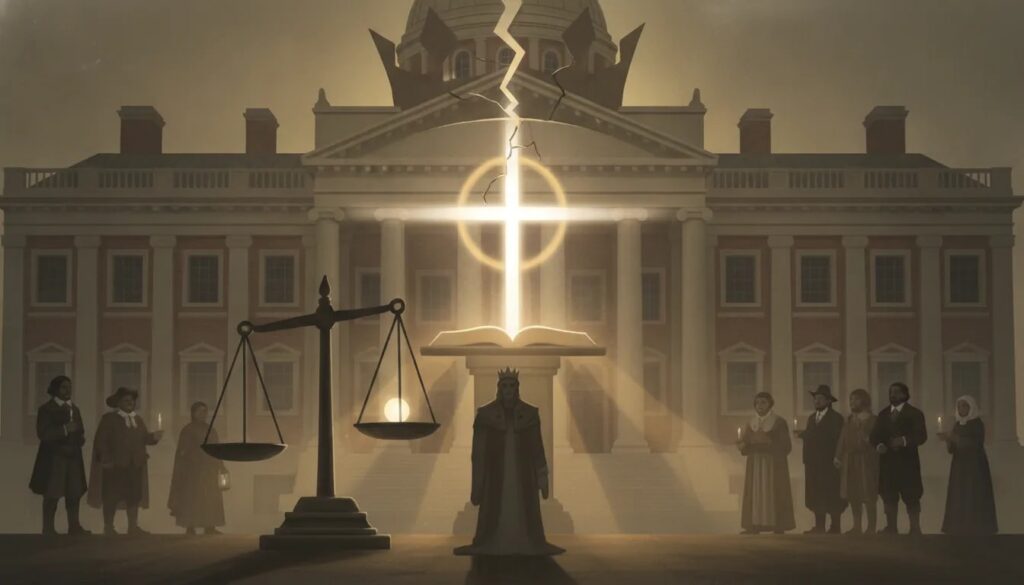
History gives us a striking answer. The cry heard among Puritans in the English Civil War and repeated by Presbyterians during the American Revolution was not merely, “No kings.” It was: “No king but Jesus.”
That is not a small distinction. It is the difference between rejecting all authority and rejecting tyrannical authority because every human authority answers to a higher King.
No Tyrants, Yes. But What Does “We the People” Mean?
There is much to agree with in the claim that America does not belong to dictators or tyrants. Absolutely. The phrase “we the people” is also revolutionary, precious, and worth defending.
But “we the people” did not arise in a vacuum. The idea that ordinary people have dignity, that political power requires the consent of the governed, and that rulers are accountable under law did not come from the ancient pagan world.
The ancient world tended to swing between two disastrous options:
- Anarchy: competing groups doing whatever seemed right in their own eyes.
- Tyranny: a ruler or ruling class imposing order through raw power.
The biblical vision offered a third way: liberty under God’s righteous rule. It was neither chaos nor domination. It was a moral order in which rulers were servants, law restrained power, and every person carried God-given worth.
This is why the historic confession “No king but Jesus” matters so much. It does not mean that human societies cannot have leaders, judges, presidents, prime ministers, or governors. It means no human being is ultimate. No ruler is God. No office holder is above the law. No state gets to demand the worship that belongs to Christ alone.
The Problem With Morality Detached From Christ
Even Friedrich Nietzsche, a passionate atheist who opposed Christianity, understood something many modern people miss. He recognized that movements seeking to abandon Christianity often still wanted to retain Christianity’s moral inheritance.
They wanted human rights, equality, compassion for the weak, moral limits on power, and concern for the oppressed. But they wanted these fruits without the root.
That is a dangerous illusion. If there is no God-given dignity, why should the strong not rule the weak? If there is no transcendent moral law, what finally stops power from becoming its own justification?
The world has seen what happens when “might makes right” becomes the operating principle. Tyranny does not stay theoretical. It crushes human beings.
Nietzsche himself imagined a world beyond Christian morality, a world in which strength and power prevailed. The problem is that everyone imagines they will be among those at the top. Very few stop to ask what happens when they are the ones beneath the boot.
Christianity did not invent the human desire for power. It exposed it, judged it, and called it sin. Then it proclaimed something astonishing: the King of all creation came not to dominate people, but to rescue them.
The Gospel Is More Than a Ticket to Heaven
Jesus died for our sins, rose from the dead, ascended to heaven, and gives eternal life to all who trust Him. That is glorious truth. We will live forever because of what Christ accomplished on the cross.
But the gospel is not merely about getting human beings out of earth and into heaven. It is also about the life of heaven breaking into earth.
Jesus taught us to pray, “Your kingdom come, Your will be done on earth as it is in heaven.” That prayer means something. It means the reign of Christ brings healing, justice, truth, mercy, freedom, dignity, and restoration wherever His people faithfully carry His life into the world.
The gospel confronts everything that robs people of their God-given worth:
- Poverty and exploitation
- Depression and despair
- Human trafficking and drug trafficking
- Corruption and unjust power
- Violence, oppression, and tyranny
People may hear that and think it is only big religious language. But history gives us reasons for hope. Entire systems of oppression that once seemed permanent have been challenged and overturned through the influence of the gospel.
Slavery Was Not Inevitable
For much of human history, slavery was treated as a normal and permanent institution. It was deeply embedded in societies across the world. Yet the Christian proclamation that every person bears God’s image and that Christ came to set captives free created a moral revolution.
The church did not always live faithfully according to that truth. Greed and compromise allowed slavery to reappear and flourish in places where Christian conviction should have confronted it. When people stray from God’s word, people suffer.
But Christians also led the long fight against slavery. The Quakers, in particular, were deeply committed opponents of slavery before and throughout America’s founding era. They were not alone, but they were tireless in their work.
This matters because it reveals a pattern: when the church understands and obeys the kingdom of God, it becomes a force for human flourishing. When the church compromises with greed, power, and the systems of the world, it loses its witness.
God works through His people. He spreads His word through communities that believe it, live it, and carry it into public life. If the gospel could confront an institution as massive and brutal as slavery, then we should not assume Jesus is powerless before the evils of our own generation.
Jesus Is King, But Not Like the Kings of This World
Some people are comfortable declaring, “Jesus is Lord,” but become uneasy when they hear, “Jesus is King.” Yet the first Christians made both declarations in direct contrast to Caesar’s claims.
Rome said Caesar was lord. The church proclaimed that Jesus Christ is Lord, Messiah, and King.
When Pilate asked Jesus whether He was the King of the Jews, Jesus did not deny His kingship. He said plainly that He was a king. But He also said, “My kingdom is not of this world.”
That phrase is often misunderstood. It does not mean Christ’s kingdom is irrelevant to this world or confined to a distant heaven. Jesus is not saying His kingdom is not for this world. He is saying it is not from this world.
His kingdom does not operate through the corrupt systems of domination, coercion, violence, propaganda, greed, and self-exaltation that characterize fallen human power.
Christ’s kingdom is not from this world, but it is for this world.
It is for the liberation of captives. It is for light in darkness. It is for blessing, truth, justice, and fullness of life. Jesus is King, but He is not a tyrant. His rule is completely unlike the kingdoms of this age.
Daniel’s Vision: A Kingdom That Will Not Be Destroyed
The book of Daniel gives us a powerful picture of God’s kingdom confronting the kingdoms of the world. Daniel interprets a vision of successive empires, represented as great powers that would rise and fall: Babylon, Medo-Persia, Greece, and Rome.
Then comes the promise: in the days of those kings, the God of heaven would establish a kingdom that would never be destroyed.
That matters because Jesus was born during the Roman Empire. Caesar issued the decree, Mary and Joseph traveled to Bethlehem, and in those days the kingdom of God entered history in a new and decisive way.
The kingdom of Christ would outlast every empire. Rome would not stand forever. Babylon would not stand forever. Tyrannies rise, boast, intimidate, and fall. But the kingdom of God cannot be destroyed.
The world often sees its systems as glorious. Scripture teaches us to see them more clearly. When governments demand ultimate allegiance, consume human lives for their own glory, and crush liberty, they become beastly. God’s kingdom exposes and overturns those systems.
Liberty Lives Between Anarchy and Tyranny
Modern political language often talks about left and right. But the framework given by America’s founders can be more helpful: anarchy on one side, tyranny on the other, and liberty in the middle.
Anarchy is not freedom. The book of Judges repeatedly describes a time when there was no king in Israel and everyone did what was right in his own eyes. That was not a golden age of personal liberty. It was a period marked by moral confusion, violence, and social collapse.
Tyranny is no better. It brings us back to Babel, Babylon, Egypt, and Rome, where a ruler or empire makes itself ultimate and expects people to serve its interests.
Liberty requires a rule of law rooted in something higher than personal preference and stronger than political force. God gave Israel a law intended to produce human dignity and flourishing. The people had been slaves in Egypt. They knew what oppression looked like. God gave them a covenant order that said human beings are not property, rulers are not gods, and justice matters.
This is why biblical freedom is never merely, “I get to do whatever I want.” Freedom is the power to become what God created us to be and to love our neighbors rightly.
The Biblical Roots of Popular Sovereignty
The Bible contains a remarkable doctrine: the kingship and priesthood of God’s people. Israel was called to be a nation of kings and priests. This does not erase leadership. It transforms the meaning of leadership.
Political authority is not an excuse for rulers to exalt themselves. It is stewardship. It is a trust held under God for the good of the people.
That is why the biblical vision is connected to the idea of popular sovereignty. “We the people” has meaning because people are not mere subjects of the state. They are responsible image bearers of God, called to participate in the life of their community.
When God gave His law, He was not simply announcing arbitrary commands from a distant throne. He was establishing covenant. The people were called to respond to Him. They were also responsible to one another before God.
This is a foundation for the consent of the governed. It is a foundation for accountable authority. It is a foundation for the conviction that government must serve people, not consume them.
Prime ministers, presidents, and other public officials are not meant to be little emperors. Their authority is derivative. They are stewards. No one is above the law.
For more teaching on faith, society, and biblical discipleship, explore the Life Springs Christian Church preaching videos.
Why Character Matters More Than Political Labels
A free society requires responsible people. Liberty cannot survive if citizens are trained merely to react emotionally, repeat slogans, and follow whoever speaks most loudly.
Critical thinking matters. Wisdom matters. Character matters.
If people place leaders in office who lack wisdom, integrity, courage, and self-control, they create a crisis with their own hands. If leaders are driven by greed, lust for power, self-importance, and corruption, they cannot govern in a way that reflects the kingdom of God.
But the problem goes deeper than bad leaders. Leaders often arise because people reward them. If people want teachers who tell them only what they want to hear, teachers will appear to supply that demand. It becomes a destructive cycle.
The way back requires courageous people who will wrestle with God’s word, refuse to compromise with the world, and grow in discernment. It requires teachers who care more about truth than popularity. It requires communities that prize wisdom over rhetoric.
That journey will not be quick. But health does not return through slogans alone. It comes through repentance, truth, formation, and faithfulness.
Separation of Church and State Is Not Separation From Truth
The church has often damaged its own witness by confusing the kingdom of God with an empire. When state and religion merge so completely that dissent becomes treason and theological disagreement becomes a crime, the result is tyranny.
History bears the scars. Catholics killed Protestants. Protestants killed Catholics. Jews were persecuted. Christians sometimes treated religious uniformity as if it were the same thing as faithfulness to Jesus.
That was a catastrophic misunderstanding of the kingdom.
The biblical distinction between kings and priests exists for a reason. The church must remain free to speak truth to power. It must form people in character and wisdom. It must not become a tool of the state, because when Pharaoh becomes god or Caesar becomes god, totalitarianism follows.
Christians should never seek to coerce faith through political force. The kingdom of God does not advance by making people outwardly conform while their hearts remain unchanged. It advances through truth, love, repentance, discipleship, and the transforming work of the Holy Spirit.
The Servant King Who Washes Feet
If there is any question about what kind of King Jesus is, John 13 settles it.
Jesus knew that the Father had given all things into His hands. He knew where He had come from and where He was going. He possessed all authority. Then He rose from supper, took a towel, poured water into a basin, and washed His disciples’ feet.
This was offensive to Peter because it overturned every worldly expectation. Kings do not wash feet. The powerful do not serve the weak. Masters do not kneel before servants.
But Jesus says, in effect, this is what My kingdom looks like.
The King serves the people. The people do not exist to serve the King.
This is the heart of servant leadership. The greatest becomes the servant of all. The meek will inherit the earth. Power does not make right. Christ’s kingdom is turning the world upside down so that earth increasingly reflects heaven rather than hell.
This is the pattern every leader should follow, whether in the home, church, workplace, or government. Leadership is not a license to take. It is a calling to serve.
Politics Cannot Save a Nation
Politics matters. Laws matter. Institutions matter. But politics cannot save America, because the deepest problem is not first external. The root problem is sin.
Jesus did not merely come to improve systems from the outside. He came as the Lamb of God who takes away the sin of the world. He put the axe to the root.
Rules alone cannot free people from jealousy, greed, corruption, lust for power, and self-deception. A society can write noble principles on paper and still destroy itself if its people are not changed.
We need more than information. We need transformed lives. We need renewed minds. We need the grace of God, the love of God, and the Spirit of God working from the inside out.
Simply putting Christians into positions of influence will not solve the problem if they have not matured in wisdom, grace, character, and knowledge of Christ. Baby Christians cannot carry the weight of kingdom responsibility. People must grow up in the faith.
That is why renewal begins personally. Every one of us needs a Savior. Every one of us needs to be delivered from sin. Every one of us needs the ongoing work of Christ in our heart.
Love Is the Foundation of Christ’s Kingdom
Jesus gave His disciples a command that reveals the visible foundation of His kingdom community: love one another as He has loved us.
This is not sentimental language. It is the shape of the church. It is how people recognize the disciples of Jesus.
Love is not an optional decoration added to Christian belief. Love is the essential characteristic of a kingdom that is not of this world but is for this world.
When the church uses worldly systems of manipulation, fear, self-promotion, and compromise, the light is hidden and the salt loses its flavor. But when the church becomes a community of truth, courage, service, holiness, mercy, and love, the leaven of the kingdom begins working again.
This is how the church captures hearts and imaginations. Not by grasping for domination, but by reflecting the King who laid aside His garments, took up a towel, and served.
No King But Jesus
Does America have a king? In the deepest sense, every nation does. The question is whether that king is the state, the crowd, a political party, a charismatic leader, human desire, or Jesus Christ.
“No king but Jesus” is not a call for theocracy, conformity, or religious coercion. It is a declaration that no human institution is ultimate. It is a declaration that rulers are servants under law. It is a declaration that liberty requires responsibility, truth, and moral formation. It is a declaration that human dignity rests in God, not government.
America’s founding vision carried important reflections of this biblical inheritance. But that inheritance cannot survive if it is separated from the faith, character, and love that gave it life.
The church must once again become a people who know Jesus and His kingdom deeply enough to bring hope to a weary world. It begins with us, in the community of faith, taking responsibility to grow in truth, wisdom, love, and courage.
No king but Jesus. Not because Jesus is another tyrant competing for the throne, but because He is the only King who gives Himself for His people, frees captives, confronts evil, restores dignity, and teaches us how to love.