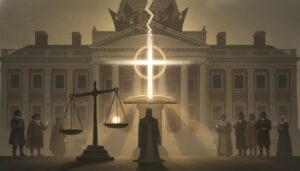

I’m Pastor Bill Brannan of Life Springs Christian Church. In this message I want to show how the church—grounded in the Sermon on the Mount and the Beatitudes—can be the healing presence our nation and world so desperately need. The call isn’t merely evangelistic in a narrow sense; it’s a summons for the church to recover its role as the soul and conscience of society so that human flourishing, liberty, and justice can be restored.
Outline
- Church as the soul and conscience of society
- The Beatitudes as the governing law of the New Covenant
- Morality, economics, and the founding vision of human flourishing
- Peacemaking and mercy—lessons from Martin Luther King Jr.
- Guilt culture vs. shame culture: diagnosing the shift
- How Christians must respond: renewal, discernment, and nonconformity
- The Sermon on the Mount: build on the Rock
Church as the Soul and Conscience of Society
The first and most urgent point: the church is the soul of society. When the church is diminished, the public square—government, the marketplace, education—loses its moral center. Early America treated the Bible as a foundational moral textbook. Communities taught children to read using Scripture because they believed moral formation leads to civic flourishing.
That doesn’t mean coercion or tribalism. It means the church is meant to be the conscience of the state—its guide and its critic, never its tool. When the church loses prophetic zeal it risks becoming a social club rather than a moral compass. And when the word of the Lord is rare in a culture, blind leaders multiply and everyone falls into a ditch.
The Beatitudes: The Law That Governs the Spirit-Filled Life
The Beatitudes are not merely pious sayings; they function like an operating system for the Holy Spirit at work in us. I believe the Beatitudes are the foundational law of the New Covenant—how the kingdom of God looks and behaves on earth.
“Blessed are the peacemakers, for they shall be called sons of God.” — Matthew 5
To live under the Beatitudes is to develop a spiritual temperament that can discern life from death, light from darkness. If we love the kingdom of heaven, we should be able to see whether a policy, a political movement, or our own rhetoric reflects the character and nature of Jesus.
Morality, Markets, and the Need for a Shared Moral Imagination
Markets and democratic politics are necessary, but not sufficient. As Rabbi Jonathan Sacks observed, economic freedom and liberal politics will fail if not undergirded by a moral sense that puts our shared humanity first. Without that third element—morality—inequalities grow and anger rises, threatening the very freedoms we cherish.
Our founders were immersed in a high-level Biblical worldview. That shaped ideas like equality, covenant, separation of powers, and the protection of liberty. Those principles are recoverable only when Christians deepen their understanding of Scripture and how it informs public life.
Peacemaking and Mercy: Learning from Martin Luther King Jr.
Martin Luther King Jr. stands out as a model peacemaker. He confronted grave injustice without becoming consumed by vindictive anger. He could call people “good” in the sense that many who supported wrong policies were sincere, even if their actions were harmful. That posture—”Father, forgive them, for they know not what they do”—is at the heart of Christian peacemaking.
“Blessed are the merciful, for they shall obtain mercy.” — Matthew 5
Mercy is a cultural seed. When the church practices mercy, it sows a society more likely to heal. When it resorts to anger and dehumanization—even when it believes it is right—it risks burning the very structures it aims to rescue.
Guilt Culture vs. Shame Culture: Diagnosing the Problem
A crucial cultural diagnosis: there are two broad moral cultures—guilt cultures and shame cultures.
- Guilt culture: Morality is inward. What matters is the voice of conscience—internalized moral imperatives. People obey what they know is right, even when no one else is watching.
- Shame culture: Morality is outward, other-directed. What matters is public image, conformity to roles and expectations. Violation brings public humiliation, ostracism, canceling.
America began as a guilt culture shaped by Biblical conscience, but in many spaces it has shifted toward shame culture—image, conformity, cancel culture, and the manipulative mechanisms of power that come with it. Ironically, parts of the church have adopted shame tactics: public shaming and coercion to enforce behavior rather than forming consciences. That shift kills flourishing; guilt cultures, rightly ordered, bring life.
Practical Signs of a Shame Culture
- Cancel culture and public shaming as the chief corrective.
- DEI and identity-driven policies operating by external markers rather than inner character.
- Affirmative measures that prioritize externals over the formation of conscience and merit.
These mechanisms may come from an understandable desire to fix injustice, but when they operate without inner transformation and moral formation they dehumanize and divide.
How the Church Must Respond: Renewed Minds, Nonconforming Minority
Romans 12:1–2 gives our blueprint:
“Do not be conformed to this world, but be transformed by the renewing of your mind, that you may prove what is that good and acceptable and perfect will of God.”
Renewal happens through disciplined engagement with Scripture. Faith grows as we hear the Word; transformation comes as we meditate and let Scripture reshape our affections and imagination. Christianity must stop being a spectator sport. Maturity requires work: reading, thinking, discussing, and applying the Word to business, politics, and culture.
We need a “creative maladjustment”—a small, faithful minority willing to be nonconforming in the best sense: refusing to accept the spirit of the age when it contradicts the kingdom of God, while offering wise, loving, and sacrificial alternatives that point people toward flourishing.
Build on the Rock: The Sermon on the Mount as a Blueprint
The Sermon on the Mount concludes with a sobering and hopeful metaphor. Jesus pleads with us to put His teaching into practice:
“Whoever hears these sayings of mine and does them…is like a wise man who built his house on the rock…But whoever hears and does not do them is like a foolish man who built his house on the sand…and great was its fall.”
This is not mere legalism. It’s a heartfelt pleading: don’t build your life, your church, or your public witness on shifting sands of anger, fear, and manipulation. Build on the Rock of Christ and His way—peacemaking, mercy, truth, and mercy again.
Concrete Steps for Christians and Churches
- Return to Scripture: cultivate daily meditation and serious study that forms conscience and discernment.
- Practice mercy: make mercy a visible habit in church life and community engagement.
- Reject shame tactics: refuse to lead or follow through public humiliation and canceling; form consciences instead.
- Engage civically with a biblical worldview: learn how Scripture speaks into economics, law, and public policy.
- Be a nonconforming minority: act creatively and sacrificially to restore liberty, justice, and human dignity.
- Pray and seek the Holy Spirit: the work requires power beyond our own—ask God to move, heal, and lead.
Conclusion: A Call to Renewal
The world needs a church that is awake, prophetic, and full of mercy. We must recapture the prophetic zeal to speak truth in love, to act without bitterness, and to rebuild institutions around the character of Christ. When the Word of the Lord is not rare among us, we can guide nations back toward life, liberty, and human flourishing.
My prayer is that the Church will hear these words and do them—becoming the city on a hill, the salt of the earth, and the light of the world. Let us be a people shaped by Scripture, governed by conscience, and empowered by the Holy Spirit to heal the broken places around us.
Let us pray.